

Veterinary Diagnostics
When your pet isn’t feeling well, answers matter more than guesswork. That’s why we’ve invested in advanced, in-house diagnostic equipment — so we can see what’s going on quickly, right here in our office, without the wait or added stress of being sent elsewhere. From digital X-rays to bloodwork to ultrasound, our team can investigate the scope and source of your pet’s ailment and get you real answers, fast.
Diagnostic Procedures
- Digital Radiographs (X-Rays)
Our modern X-ray technology lets us magnify images and adjust brightness and contrast to assess multiple body parts from a single exposure, and we also have a digital unit dedicated specifically to dental X-rays. X-rays can reveal bone fractures, tumors, degenerative joint disease, dislocated joints, elbow and hip dysplasia, GI obstructions, kidney stones, uterine infections, enlarged organs, sinus disorders, and heart and lung health — which is why we generally require X-rays prior to anesthesia. We evaluate most X-rays in-house, and partner with board-certified radiologists for second opinions on questionable findings. - Ultrasound
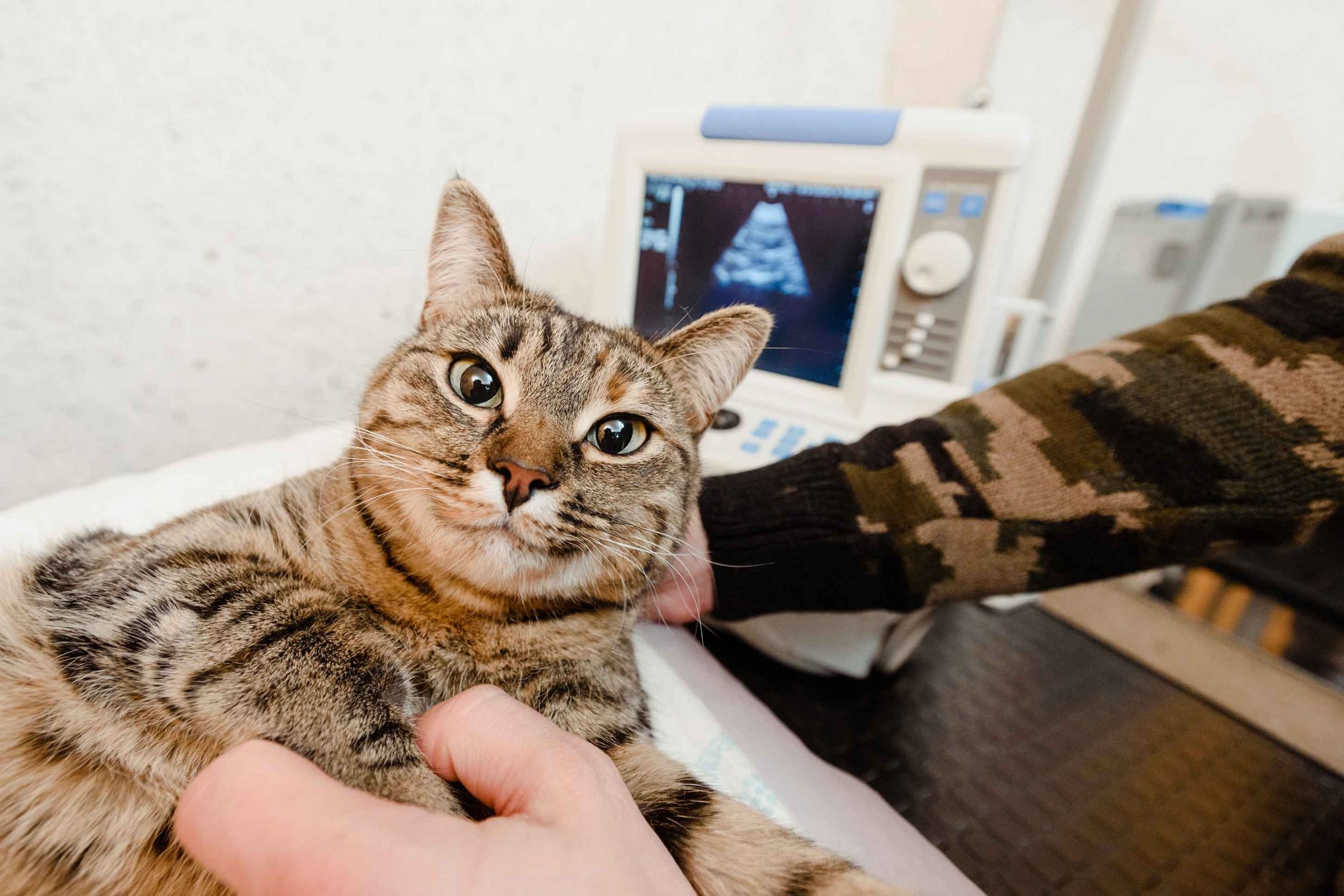
Our in-house ultrasound technology can help us quickly identify what’s ailing your pet. Ultrasound offers a detailed view of your pet’s internal organs, ligaments, tendons, and eyes. It’s generally low-stress — anesthesia isn’t necessary in most cases, and only minimal restraint is required. If your pet has abnormal lab results or a painful or swollen abdomen, an ultrasound can give us more information. After major trauma — like being hit by a car or attacked by another animal — an ultrasound can help us quickly identify and respond to life-threatening conditions such as internal bleeding and organ damage. - Contrast Studies
Contrast studies are special radiographic procedures that let us visualize hollow body structures such as the esophagus, stomach, intestines, colon, bladder, kidneys, uterus, and draining tracts caused by penetrating foreign bodies. They use a radio-dense liquid, given orally, through a catheter, or injected into the bloodstream, allowing us to see movement or blockages in the GI tract, assess the stomach and intestinal walls, evaluate kidney structure and urine flow, check bladder integrity, and locate a retained or migrating foreign body. - Tonometry
Tonometry measures the fluid pressure in your pet’s eye, useful for diagnosing uveitis and glaucoma. - Endoscopy
An endoscope lets us examine the nasal passages, ears, trachea, esophagus, stomach, rectum, and colon — and lets us sample tissue or retrieve foreign bodies, like cheat grass barbs or swallowed toys. - Echocardiogram
We partner with a local veterinary cardiologist to review echocardiograms and direct advanced cardiac care.
In-House Lab Services
- Complete Blood Count (CBC)
A CBC measures and categorizes the cellular composition of blood — red blood cells, white blood cells, and platelets — and reflects disease processes such as anemia, dehydration, infection, inflammation, stress, and blood-origin cancers. - Blood Chemistry
Measures blood levels of glucose, electrolytes, proteins, metabolic byproducts, and enzymes that reflect problems with organs like the liver, kidneys, heart, intestines, and bone, along with blood pH — a critical factor in metabolic function. Abnormalities can reveal diabetes, Addison’s disease, Cushing’s disease, liver and kidney failure, pancreatitis, and more. - Urinalysis
An analysis of the cellular and chemical composition of urine to detect conditions such as urinary tract infection, renal insufficiency, diabetes, glomerulonephritis, feline urinary syndrome, bladder cancer, and others. - Cytology
The sampling, staining, and microscopic evaluation of skin scrapings, impression smears, fine needle aspirates, and other slide preparations. - Parasite Analysis
In-house and outside lab evaluation of internal and external parasites, including heartworm. - Fecal Analysis
Used to identify pathogens such as giardia, coccidia, toxin-producing bacteria, intestinal viruses, and other conditions affecting the gut.